Why We Believe
8. Christ in the Old Testament (Part 2)
8. Christ in the Old Testament (Part 2)
He said to them, "How foolish you are, and how slow to believe all that the prophets have spoken! Did not the Messiah have to suffer these things and then enter his glory?" And beginning with Moses and all the Prophets, he explained to them what was said in all the Scriptures concerning himself. (Luke 24:25-27 NIV)
Psalm 22
When Jesus was languishing on the cross, the New Testament reports that he recited the first verse (Matthew 27:46 and Mark 15:34) and the last verse (John 19:30) of Psalm 22. It appears that the gospel writers were intimating that Jesus was reciting the entire Psalm while on the cross living out the prophecy before all. The events that happened at the cross of Christ parallels explicitly what was described in Psalm 22.
In the Psalms of David leading up to the 22nd Psalm, we can see a picture being painted of a king in distress and at the same time a vision of a future king from his lineage undergoing the ultimate stress. Psalm 2 opens with a documentation of those raging against the Lord of Heaven and His Anointed. The Anointed One is revealed as the Son of YHWH. It is clear that David is not just speaking of himself but is also speaking about the Anointed One as his descendant, the Messiah. Psalm 3 continues the picture of the king under attack but in verse 5 “I lay down and slept; I woke again, for the Lord sustained me” intimates Psalm 23 and seems to speak of a dying and rising again. Many of the Psalms that follow continue a focus on the distress of the Anointed One. In Psalm 8, David uses one of the titles of Jesus in the New Testament “Son of Man” who is made a little lower than the angels but then gets dominion of the creation. The writer of Hebrews in 2:7-9 quotes Psalm 8 as a description of Jesus! Psalm 16:10 appears to predict the death and resurrection of Jesus. It can’t be David because he remains in the grave.
In Psalm 22:1 the abandonment of God's Anointed is questioned. This is followed with a description of mocking against the Anointed One in verses 6-8 that is eerily predictive of Jesus on the cross as recorded in Matthew 27:41-44; Mark 15:30-32; Luke 23:35-37. In verses 9 and 10, David speaks of an earthly mother but not of an earthly father. It is clear that David is not talking about himself. In verses 12-18, David is describing an experience that was not his own: ravenous wild animals, also described as a company of evildoers, are wounding him while he is defenseless. You can see his bones through his skin, he is stripped naked and his tormentors cast lots to determine who will get his clothes. This is what happened to Jesus as recorded in Matthew 27:35; Mark 15:24; Luke 23:34 and John 19:23. In verses 24 and 25 God hears the cries of suffering, but we know in verse 29 that the Anointed One dies. He apparently rises to live again in Psalm 23.
Finally, David ends Psalm 22 with “he has done it” which is echoed by Jesus on the cross “It is finished.”
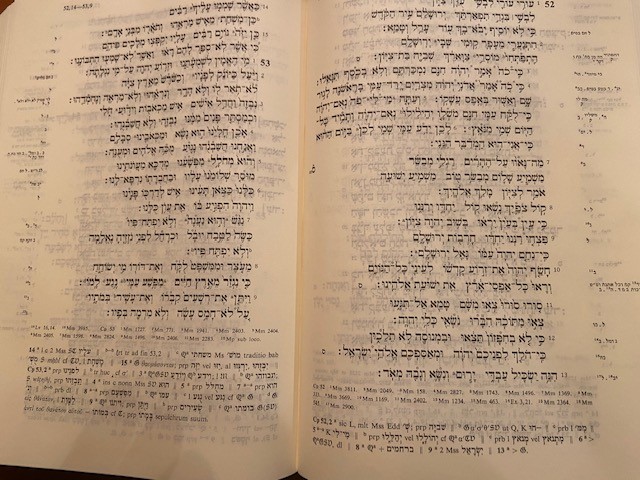
The verse that brings the greatest controversy is Psalm 22:16b/17 “they pierced my hands and my feet”. The majority Masoretic Test (MT dated 900 AD) has “like a lion my hands and my feet” which makes no sense and leaves the passage without a verb. An older Hebrew manuscript (found at Nahar Hever on the west side of the Dead Sea and dated 50-100 AD) has “they dug/pierced my hands and feet” which agrees with the Septuagint (LXX).7 Skeptic Paul N. Tobin once ran a now outdated website in which he attacked the use of the Nahar Hever inscription and LXX translation “they pierced my hands and my feet” apparently because these two witnesses of the passage clearly speak of Jesus 1000 years before He was crucified. Most scholars have understood that the Greek and Hebrew texts found at the Nahar Hever site show the LXX to be a credible witness to what the original text actually said.
Tobin has a definite bias referring pejoratively to “fundamentalists” and “evangelicals” apparently as ones who do sub-standard scholarship because they are from theological seminaries and not from major universities. This is simply not true. In fact, he himself quotes sparingly from reputable sources and much of his material comes from a biased Jewish source “Outreach Judaism.”8 Though he has an engineering degree, he does not appear to have an advanced degree in biblical or historical studies.9 He admits that the LXX was completed BEFORE the time of Jesus, but does not understand the nature and use of the LXX by Christians. He does not understand that the Masoretic text was based on one of SEVERAL versions. It became the standard partly as a response to Christian use of the Old Testament.
Tobin claims that the LXX was co-opted by the early Christians to prove the crucifixion even though the Septuagint translation could not possibly be a description of the crucifixion because the event described happened before Jesus’ time. My reply is that of course the LXX translators were not trying to describe the crucifixion. That is what makes the use of the LXX word orussõ meaning “to dig” so remarkable! They got this from a Hebrew text in use at the time (like the one found at Nahar Hever). To “dig” something means to make a hole. Isn’t that what happened to Jesus! The broader context with the rest of Psalm 22 and other scriptures like Zechariah 12:10 and Isaiah 53:5 which use different words for “pierce” make this certainly descriptive of Jesus. Besides, whether the word is “like a lion” or “dig” it is evident that SOMETHING happened to Jesus’ hands and feet!