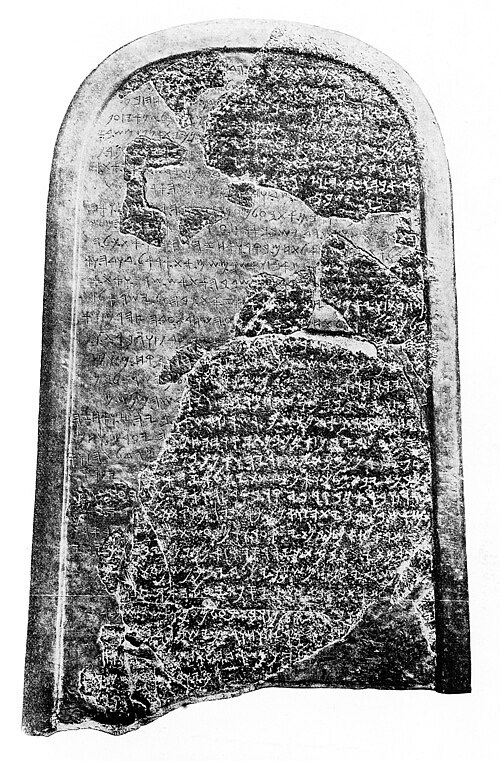
Mesha Stele
King Mesha of Moab, of whom the Mesha Stele was named, was a contemporary of Ahab’s successor and son, Joram, king of Israel and Elisha, prophet in Israel. Mesha is mentioned in 2 Kings 3:4f as a vassal of Ahab, and as one who rebelled under King Joram. Joram then called upon King Jehoshaphat of Judah to help him quell this rebellion and they agreed to attack Mesha through the desert of Edom (3:8). The campaign against Mesha was only partially successful as they failed to conquer Qir-Hareshet (likely the same as Kerak). Mesha was able to consolidate his power. Jehoshaphat returned to Judah and Joram became more concerned from pressure by Hazael of Aram in the north.
The Mesha Stele commemorates the destruction of the Omride dynasty and the confusion in the northern kingdom of Israel resulting from pressure from Hazael. The Stele apparently has more to do with this later confusion (described in 2 Kings 10:32-33) and not the earlier campaign by Israel and Judah against Mesha in 2 Kings 3. Therefore, dating is about 30 years after the usual dating of 840 BCE for the battle mentioned in 2 Kings 3.
The Mesha Stele was first discovered in 1868 at the site of biblical Dibon. A paper squeeze (paper-mâché impression) of the Stele was made shortly after discovery. Unfortunately, the Stele was broken in several pieces soon after the squeeze was made. French archeologist Charles Clermont-Ganneau restored the text from the squeeze and the fragments recovered after the damage. Eventually the Stele was reconstructed and found its way to the Louvre in Paris. In 2015 a series of sophisticated photos were taken of the Stele and squeeze that were able to show more detail than had previously been seen and more evidence of a second “house of David” reference (the first being Tel Dan) could be argued.1 Previously, a rival opinion had prevailed that the reference to David was actually a reference to King Balak mentioned in Numbers 22-24.2
米沙石碑
米沙石碑就是以摩押王米沙命名的,他与亚哈的继承人和儿子、已故的以色列王约兰以及以色列的先知以利沙同时代。 列王纪上 3:4f 中提到米沙是亚哈的附庸,但在约兰王手下反叛。 约兰随后请求犹大王约沙法帮助他平息叛乱,他们同意通过以东沙漠进攻米沙(3:8)。 由于未能征服 Qir-Hareshet(可能与 Kerak 相同),针对 Mesha 的战役只取得了部分成功。 米沙能够巩固他的权力。 约沙法回到犹大,约兰更担心北方亚兰人哈薛的压力。
Mesha Stele 纪念 Omride 王朝的毁灭以及在 Hazael 的压力下以色列北部王国的混乱。 石碑显然与后来的混乱有更多关系(在 2 Kings 10:32-33 中有所描述),而不是以色列和犹大在 2 Kings 3 中对 Mesha 的较早战役。因此,约会是在通常约会 30 年后 2 Kings 3 中提到的战斗公元前 840 年。
Mesha Stele 于 1868 年在圣经中的底本遗址首次被发现。 石碑被发现后不久便被压纸(纸压印)。 不幸的是,石碑在挤压后不久就碎裂成几块。 法国考古学家 Charles Clermont-Ganneau 从挤压中恢复了文字,损坏后恢复了碎片。 最终,石碑被重建并运往巴黎的卢浮宫。 2015 年,为石碑和挤压拍摄了一系列复杂的照片,这些照片能够显示比以前看到的更多细节,并且可以争论第二个“大卫之家”参考(第一个是 Tel Dan)的更多证据。1 此前,一种反对意见盛行,认为大卫的提法实际上是指民数记 22-24 中提到的巴拉克王.2
Below is a translation by Klaas Smelik (“house of David” reference in bold) 以下是 Klaas Smelik 的翻译(“大卫之家”以粗体显示:3
- [1] I am Mesha, the son of Kemoš-yatti, the king of Moab, from Dibon. My father was king over Moab for thirty years, and I was king after my father.
- [2] And in Karchoh I made this high place for Kemoš [...] because he has delivered me from all kings, and because he has made me look down on all my enemies.
- [3] Omri was the king of Israel, and he oppressed Moab for many days, for Kemoš was angry with his land. And his son succeeded him, and he said - he too - "I will oppress Moab!" In my days he did so, but I looked down on him and on his house, and Israel has gone to ruin, yes, it has gone to ruin for ever!
- and died). And the king of I[s-]
- [4] Omri had taken possession of the whole land of Medeba and he lived there in his days and half the days of his son, forty years, but Kemoš restored it in my days. And I built Ba'al Meon, and I made in it a water reservoir, and I built Kiriathaim.
- And Hadad went in front of me, [and] I departed from [the]seven [...-]
- [6] And the men of Gad lived in the land of Ataroth from ancient times, and the king of Israel built Ataroth for himself, and I fought against the city, and I captured, and I killed all the people from the city as a sacrifice for Kemoš and for Moab, and I brought back the fire-hearth of his Uncle from there, and I hauled it before the face of Kemoš in Kerioth, and I made the men of Sharon live there, as well as the men of Maharith.
- of cha-]
- [7] And Kemoš said to me: "Go, take Nebo from Israel!" And I went in the night, and I fought against it from the break of dawn until noon, and I took it, and I killed its whole population, seven thousand male citizens and aliens, female citizens and aliens, and servant girls; for I had put it to the ban of Aštar Kemoš. And from there, I took the vessels of YHWH, and I hauled them before the face of Kemoš.
- [8] And the king of Israel had built Jahaz, and he stayed there during his campaigns against me, and Kemoš drove him away before my face, and I took two hundred men from Moab, all its di-vision, and I led it up to Jahaz. And I have taken it in order to add it to Dibon.
- [9] I have built Karchoh, the wall of the woods and the wall of the citadel, and I have built its gates, and I have built its towers, and I have built the house of the king, and I have made the double reservoir for the spring, in the innermost of the city. Now, there was no cistern in the innermost of the city, in Karchoh, and I said to all the people: "Make, each one of you, a cistern in his house." And I cut out the moat for Karchoh by means of prisoners from Israel.
- [10] I have built Aroer, and I made the military road in the Arnon. I have built Beth Bamoth, for it had been destroyed. I have built Bezer, for it lay in ruins.
- [11] And the men of Dibon stood in battle-order, for all Dibon, they were in subjection. And I am the king over hundreds in the towns which I have added to the land.
- [12] And I have built the House of Medeba and the House of Diblathaim, and the House of Ba'al Meon, and I brought there [...] the flocks of the land.
- [13] And Horonaim, the House of David lived in it. And Kemoš said to me: "Go down, fight against Horonaim!" I went down [...] and Kemoš restored it in my days. And [...] from there [...]
- [14] And I [...]