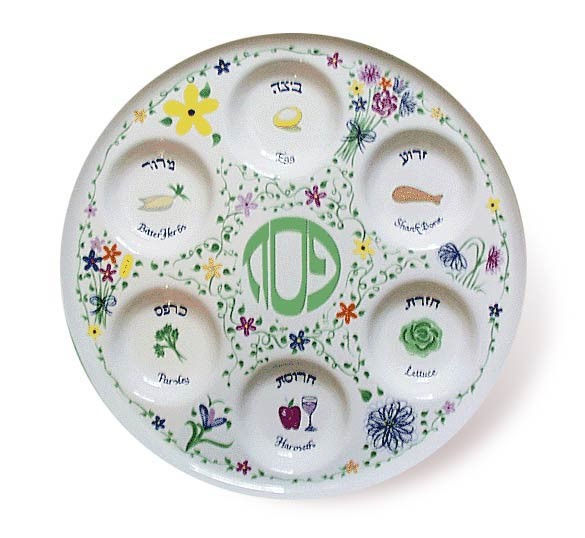
the Passover
逾越节
逾越节
The Last Supper was a Passover Seder. I arrive at this conclusion based on the following pieces of evidence:
1. The synoptic gospels (Matthew, Mark and Luke) all explicitly refer to the Last Supper as a Seder. Therefore, a denial of the fact of a Last Supper/Passover Seder contradicts clear statements of Scripture.
Matthew 26:17-21; Mark 14;12-18; Luke 22:7-16. Luke 22:15 is the most explicit reference to this last supper as a Seder. The disciples are sent by Jesus into the city (Jerusalem) to a man who would provide a place to have the Passover meal. The disciples arrived and prepared the place (cleaned out the leaven). That evening, Jesus arrived to eat. The pericope continues with expressions indicating unmistakably that the meal was a Passover Seder. For example, the dipping into the bowl (Matthew 26:23; Mark 14:20) marks the beginning of the meal. It involves eating a piece of matzah and dipping the ‘sop’ (piece of lamb, matzah and bitter herbs). In John 13:36, Jesus gives the ‘sop’ to Judas.1 The breaking of the bread and the drinking of the wine (Matthew 26:26-28; Mark 14:22-24; Luke 22:19-20), which becomes our Christian eucharist or communion is actually the third cup of the Seder and the remaining one-half matzah (afikoman) (cf.1 Corinthians 11:25, 26)2
2. John’s apparent differences with the synoptic gospels can be reconciled. John appears to state that the Seder was celebrated after the crucifixion.
John 13:1. “Before the feast of the Passover…” From this verse we know that the washing of the feet of the disciples came before the Passover. Does this mean before the actual meal, or before the day the feast was to be eaten? The word azumos (Matthew 26:17) means “unleavened bread” and is used in the synoptic gospels to designate “Feast of Unleavened Bread” the holiday, rather than a particular meal. Because the word eortē or “feast” (John 13:1) is used here with reference to the Passover, and because of references to “eat the Passover” in the gospels, the phrase “before the feast of the Passover” most likely means right before the Seder meal.
John 18:28. The Jews referenced here would be the Jewish leaders such as Caiaphas and the Sanhedrin. They obviously had not yet eaten the Passover meal. However, Jesus was now before Pilate and, therefore, had already had his last supper. This verse leads many to either claim a discrepancy between the synoptics and John, or to insist that Jesus’ Last Supper was not a Passover Seder.
However, research from the Dead Sea Scrolls now proves that there were at least two, and maybe more, competing calendars during the Second Temple Period. The Temple leadership and the Pharisees used a lunar calendar while the lesser priests and other Jews used a solar calendar or a modified lunar/solar calendar. A particularly thorny problem was when to celebrate feast days.3 The 14th of Nisan or first day of the Feast of Unleavened Bread (Pesach) when the meal was supposed to be eaten, took place on Friday night for the Jewish leadership who were following the lunar calendar, and Jesus and his disciples using a solar calendar, celebrated the Seder the evening before at his Last Supper. Later, after the destruction of the Temple, the Pharisees reorganized Judaism around the lunar calendar.
The apostate Bart Ehrman declares another contradiction concerning the phrase in John 19:14 (cf. 19:42) “It was the day of the preparation of Passover Week.”4 John is understood to be saying that Jesus was before Pilate “the afternoon before the Passover meal was eaten” whereas the synoptic gospels declare that Jesus was before Pilate the morning after the meal was eaten. This “discrepancy” was effectively dealt with in 1931 by Charles Torrey and also presently by Samuele Bacchiocchi.5 The phrase “participation” (paraskeuē) was a “technical designation” for Friday and adopted by the early church. The (literally) “preparation of Passover” (paraskeuē tou pascha) was the Friday of Passover Week which the NIV translates correctly. We can also understand that this “preparation” was a double duty performance for the Jewish leadership using the lunar calendar for on this occasion the Seder fell on eve of the Sabbath.
Regarding the timing of the events preceding the crucifixion, it would be better to understand that John was following the Roman numbering system that followed directly after midnight, while the Synoptic gospels were following a Palestinian numbering system which begins at six am. Therefore, when John says Jesus was before Pilate at the sixth hour, or 6 am, Mark is saying that Jesus was crucified at the third hour, or 9 am. Jesus was still on the cross until at least 3 pm and was removed from the cross before the special Passover Sabbath would begin at sundown.