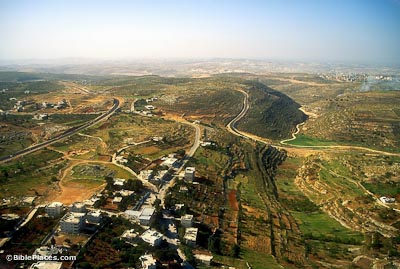
Joshua 7 and 8 tell the story of Israel’s initial overconfidence after the defeat and destruction of Jericho. A man of Judah had sinned by stealing gold and silver items from Jericho after God had told the people they were to destroy everything. Everything was dedicated to destruction (חֵ֕רֶם haram/ban). Israel lost a first skirmish with Ai and when Joshua discovered that Achan was the perpetrator, he and his family were dedicated to destruction along with the items from Jericho. Ai was subsequently defeated in battle and destroyed.
The conquests of Jericho and Ai ( הָעַ֞י the heap/the ruin) has long been a part of a larger discussion about the inability of secular archaeologists to find any meaningful remains of a 15th century BCE Jericho (evidence of destruction was claimed for 12th century) or a fortified city described by the Bible as Ai. Archaeological site evidence for Ai at the presumed site, Et-Tell, has led to the conclusion that the biblical Ai is fictitious. A reason why Et-Tell was thought to be the site for biblical Ai was that it was a mound in the vicinity and these mounds, or tells, often contained artifacts. Excavations there were conducted by French archaeologists 1933-1935, and by Joseph Calloway 1964-1970.1 Because nothing of significance came of the excavations, skeptical scholars have concluded that the books of Exodus and Joshua were works of fiction. That was also the conclusion of biblical scholars motivated by the Documentary Hypothesis of the nineteenth century which placed the writing of these books in the seventh century BCE, long after the events recorded.
To understand this thinking, I would ask the reader to review my previous article about Mount Ebal. With the plausible discovery of curse tablets with the names of God (el) and YHW (YHWH) dated to 1400 BCE the theory that there was no Israelite activity in the area at the time of Joshua may need to be revised.
William Dever claimed that “the location of biblical Ai is not in dispute.”2 This may be an incorrect conclusion because the excavations may have been made in the wrong place! A newer excavation made in 1995-2017 at Khirbet el-Maqatir may be more geographically compatible with the biblical site of Ai, and the excavations appear to have been fruitful.
Some highlights of what has been discovered include pottery from Bronze Age I that has been re-fired and is consistent with destruction. Also, Egyptian scarabs from the Middle Bronze Age III period (1650-1485 BCE) were found. This is consistent with occupation and destruction at the time of Joshua’s conquest. Aside from the items discovered, Khirbet el-Maqair appears to be a better candidate for the biblical Ai because it has a nearby hill next to Wadi-Sheban where Joshua’s army could have hidden for ambush (Joshua 8:9-12), and it is due east of Bethel / el-Bireh (Joshua 7:2; 12:9). Excavations at Khirbet el-Maqatir show a small border fortress dating to the Middle and Late Bronze Ages and a gate on the north side (Joshua 8:1) with two socket stones and four others found nearby. A more complete record and description can be found at https://biblearchaeologyreport.com/2019/04/12/biblical-sites-ai/ by Brian Windle.
《约书亚记》第 7 和第 8 章讲述了以色列人在起初击败和摧毁耶利哥后过于自信的故事。当时,犹大的一名男子犯了罪,他从耶利哥偷取了金银等物,而上帝已告知百姓要摧毁一切。所有东西都被定为要摧毁的对象חֵ֕רֶם,haram)。以色列人在与艾城的首次交战中失利,当约书亚发现亚干是罪魁祸首时,他和他的家人连同从耶利哥得来的物品一起被定为要摧毁的对象。随后,在战斗中击败并摧毁了艾城。
关于耶利哥和艾(希伯来语:הָעַ֞י ) 的相关考古证据一直是学术界争议一部分,世俗考古学家无法找到任何公元前 15 世纪耶利哥(据称有证据表明其毁于公元前 12 世纪)或圣经中所描述的设防城市艾城有意义的遗迹。关于艾城,在推测地点Et-Tell的考古遗址证据,已促使人们得出结论:圣经中的艾城是虚构的。Et-Tell之所以被认为可能是圣经中提到的艾城的遗址,是因为它附近有一座土丘,而这些土丘或称为“Tells”的地方通常都存有文物。那里的发掘工作由法国考古学家在 1933-1935 年期间进行,之后由Joseph Calloway在 1964-1970 1 年期间继续进行。由于发掘工作并未取得任何有意义的成果,持怀疑态度的学者便断定《出埃及记》和《约书亚记》是虚构之作。这也是受到 19 世纪文献假设理论影响的圣经学者的结论。该理论认为这些书的撰写时间是在公元前 7 世纪,远远晚于圣经中所记载事件发生的年代。
为了理解这种观点,我请读者回顾我之前关于以巴路山的文章。随着可能刻有上帝(el)和 YHW(YHWH)名字的诅咒石板的发现,其年代可追溯至公元前 1400 年,关于在约书亚时代该地区没有以色列人活动的理论可能需要进行修订。
William Dever声称:“圣经中艾城的所在地并无争议。2 这可能是一个错误的结论,因为挖掘工作可能是在错误的位置进行的!1995 年至 2017 年间在Khirbet el-Maqatir进行的最新一次挖掘工作,在地理位置上或许与圣经中描述的艾城更为相符,而且这些挖掘工作似乎取得了丰硕的成果。
发现的一些亮点包括青铜时代I时期的陶器被重新烧制,与破坏的迹象一致。此外,还发现了来自中青铜时代III时期(公元前1650年至前1485年)的埃及方砖。这与约书亚征服时占领和破坏的情况相符。除了发现的物品外,Khirbet el-Maqair似乎更适合作为圣经中艾的遗址,因为它附近有一座山,位于Wadi-Sheban旁边,约书亚的军队可能曾在此隐藏以进行伏击(约书亚记 8:9-12)。此外,它位于伯特利/比尔哈(约书亚记 7:2;12:9)的正东方。在Khirbet el-Maqair遗址进行的挖掘工作显示,这里曾有一座小型边境要塞,其历史可追溯至中、晚青铜时代。要塞北侧有一道城门(约书亚记8 :1 )。附近还发现了两块承重石和另外四块承重石。更详尽的记录和描述可在以下Brian Windle的网址查阅:https://biblearchaeologyreport.com/2019/04/12/biblical-sites-ai/