A 2,700-year-old cuneiform inscription on a 2.5-centimeter clay tablet was discovered in 2025 after wet sifting through excavated materials from the Western wall of the Temple Mount. The script is Akkadian and mentions a prominent chariot rider, perhaps a royal official, and announces a failure to make payment to the Assyrian court by the Judean king. The Judean king could be Hezekiah, Manasseh or Josiah, but it is most likely Hezekiah after his rebellion against Sennacherib, king of Assyria mentioned in 2 Kings 18:7, resulting in an attack by the Assyrian king on Judah.1
The excavations were conducted by the Israel Antiquities Authority and the City of David Foundation. This find has tremendous significance because it is the first ever confirmation outside of the Bible of communication between the Assyrian king and the kingdom of Judea.
The inscription appears to be from a bulla, a piece of clay used for sealing official court documents. This can be confirmed by the thinness of the material and the impression of a string on the back. Bullae act as a kind of summary or abstract of the document contents. The clay itself was determined by laboratory investigation to have come from the Assyrian valley perhaps from the shore of the Tigris River itself. The inscription dates itself to the month of “Av” which corresponds to July to August.2
The month of Av (which means “father”) is significant in Jewish history. In this month both the first and second temples were destroyed. Each year the Jewish people commemorate Tish B’ Av during the month of Av as a time of mourning due to the temple destruction and the exile to Babylon.3
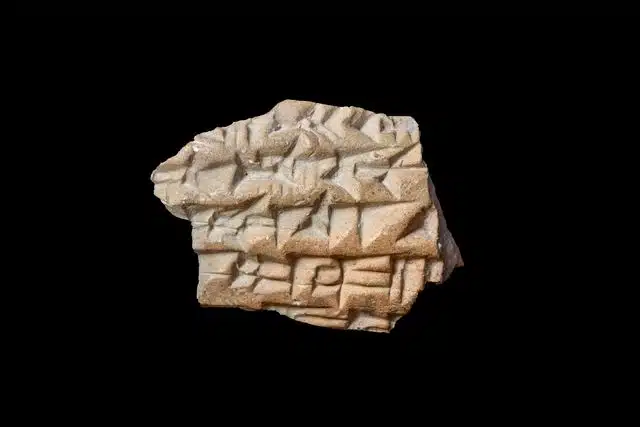
Assyrian royal seal impression. Credit: Eliyahu Yanai / Israel Antiquities Authority
一块距今已有 2700 年历史的楔形文字泥板,长 2.5 厘米,于 2025 年,在一次对圣殿山西墙挖掘出的材料的湿筛分选过程中被发现。铭文采用阿卡德语,内容提及一位显赫的战车驭手,可能是一位王室成员,并宣告犹太王未能向亚述王支付款项。这位犹太王可能是希西家、玛拿西或约西亚,但最有可能的是希西家,因为他曾反抗亚述王西拿基立,此事在《列王纪下》第 18 章第 7 节中有所提及,最终导致亚述王对犹大的攻击。1
此次发掘工作由以色列文物局和大卫城基金会负责进行。这一发现意义重大,因为这是首次在《圣经》之外确认亚述王国与犹太王国之间的交流联系。
该铭文似乎出自一种“印章泥封”,一种用于封固官方文书所用的陶片。这一点可通过材料的厚度以及背面绳索的痕迹得到证实。泥封起着对文书内容的一种概括或摘要的作用。经实验室分析确定,陶泥原料本身源自亚述河谷,可能来自底格里斯河沿岸地区。铭文所标注的时间为“埃波”月,这对应公历的七月到八月之间。2
“埃波”月(埃波,意为“父亲”)在犹太历史上具有重要意义。在这个月里,第一座和第二座圣殿均遭到摧毁。每年犹太人都会在“埃波”月第九日纪念圣殿被毁,以此作为对圣殿被毁及被放逐到巴比伦时期的哀悼。3