In 2008, a French marine archaeological team led by Franck Goddio, exploring the submerged harbor off Alexandria, Egypt, came upon an obviously very old cup, with a Greek inscription. Further investigation showed that the cup dated to the first century and that the inscription read ‘DIA CHRSTOU O GOISTAIS’ (Through Christ the Enchanter). It was in remarkable shape and only missing its handle. It has since been named the ‘Jesus Cup. It was discovered on the now submerged island of Antirhodos located in the harbor. The famous Egyptian Queen, Cleopatra, also had a palace on the island.
According to New Testament scholars, what is even more incredible is that this cup is dated to the first century. The discovery of this cup apparently shows that Jesus’ reputation was already spreading by word of mouth throughout the Roman empire in the first century.
The use of the term ‘enchanter’ suggests that whoever designed and/or used the cup was not necessarily a Christian. Following the death and resurrection of Jesus, some vagabond magicians would try to invoke the mystical and magical powers of Christ in dealing with evil spirits after observing believers like Paul (Acts 16:16-18). We have a record of this kind of action in Acts 19:13 “Some Jews who went around driving out evil spirits tried to invoke the name of the Lord Jesus over those who were demon-possessed. They would say, "In the name of the Jesus whom Paul preaches, I command you to come out." (NIV)
“For believers today, discoveries like the “Jesus Cup” remind us that the name of Jesus has always carried undeniable power. Long before church buildings or denominational structures, the fame of Jesus [was ispreading].”1
We know that it was common practice that items such as cups were used for spiritual purposes in this part of the mediterranean world. However, detractors say that the inscription “Christou” could actually be “Chrestou”, meaning “good” or “kind” in Greek, not necessarily referring to Jesus. Together with the accompanying word” Goistais” the inscription could mean “good magician” or “kind enchanter.” Nevertheless, it is significant that this cup apparently fits the biblical evidence and known practices of enchanters of this period.2
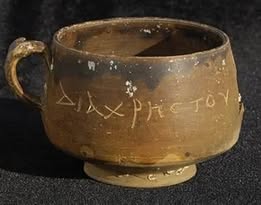
2008年,一支由弗兰克·戈迪奥(Franck Goddio)率领的法国海洋考古队在埃及亚历山大港外海域探索一处沉没的港口时,偶然发现了一只显然年代久远且刻有希腊铭文的杯子。进一步的考证显示,这只杯子可追溯至公元一世纪,其上的铭文意为“DIA CHRSTOU O GOISTAIS”(借由基督——那位魔法师)。这只杯子保存状况极佳,仅缺失了把手。此后,它便被命名为“耶稣杯”。这只杯子是在位于港口内、如今已沉入水下的安提罗多斯岛(Antirhodos)上被发现的。著名的埃及女王克利奥帕特拉(Cleopatra)也曾在这座岛上拥有一座宫殿。
据新约学者考证,更为令人难以置信的是,这只杯子的年代可追溯至公元一世纪。这只杯子的发现显然表明,早在公元一世纪,耶稣的声名便已通过口耳相传的方式传遍了整个罗马帝国。
“魔法师”(enchanter)一词的使用表明,无论设计还是使用这只杯子的人,未必都是基督徒。在耶稣死而复活之后,一些四处游荡的术士在目睹了保罗等信徒的作为后(《使徒行传》16:16-18),也试图借用基督那神秘而神奇的力量来驱逐邪灵。我们在《使徒行传》19:13中便读到了关于此类行径的记载:“那时,有几个周游各处、念咒赶鬼的犹太人,向那被恶鬼附的人擅自称呼主耶稣的名,说:‘我奉保罗所传的耶稣,命令你们出来!’”
对于当今的信徒而言,像“耶稣杯”这样的发现提醒着我们:耶稣之名始终蕴含着不可否认的力量。早在教堂建筑或教派体系形成之前,耶稣的声名便已广为流传
我们深知,在这一片地中海地区,将杯子等器物用于灵性用途乃是当时的一种普遍习俗。然而,持异议者指出,铭文中的“Christou”一词实际上可能是“Chrestou”——在希腊语中意为“好的”或“仁慈的”——因此未必特指耶稣。若结合其后的伴随词“Goistais”来看,整段铭文或许意指“善良的魔法师”或“仁慈的施法者”。尽管如此,这只杯子显然与《圣经》中的相关记载,以及当时巫师群体的已知习俗都高度吻合,这本身就具有重大意义。